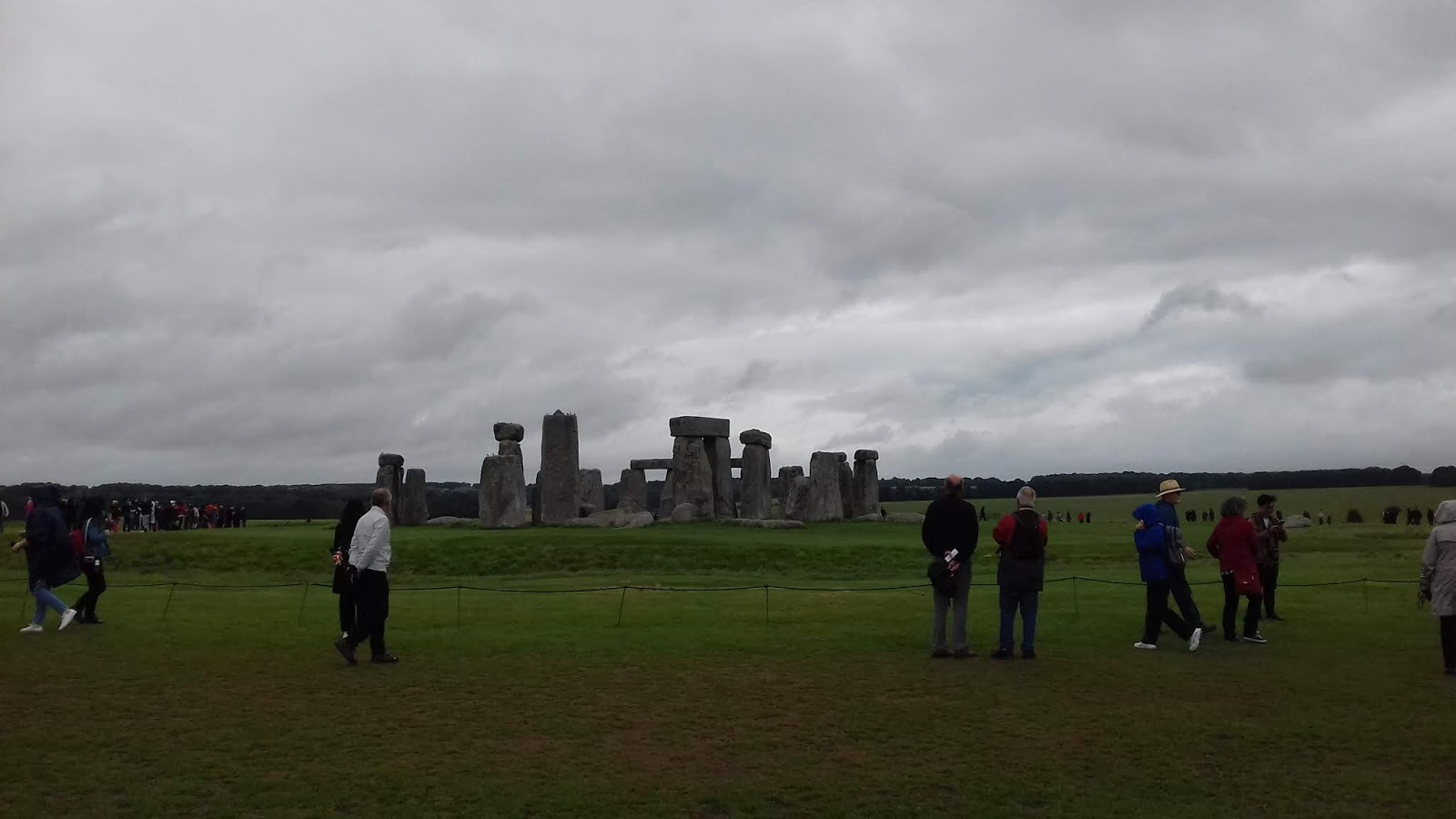
With a history spanning 4,500 years, Stonehenge had been a
national monument I had wanted to visit for a long time. This was our last stop in our Wiltshire weekend
and I was the only one, out of three of us, who had never been. My companions
reserved their opinions until I had had chance to witness the stones for
myself.
Stonehenge is busy, even when other places are out of season.
It is an endless movement of people in queues on foot, on buses and around the
henge itself. Visitors from several continents are among us as we chatter in
the line, waiting to show our prepaid tickets. We bypass the shop and
restaurant so we can get to the circle early and avoid most of the crush. But
it is still bustling as we wait for a bus to drive us down the long approach.
I’m nervous, as I dislike crowds and my claustrophobia begins as we jostle into
the bus and stand for the journey. Passing fields, with other burial mounds,
and small, relatively young clusters of forest, we eventually arrive.

It’s not as large as I’d envisaged, though exactly how large
I thought it was I cannot say! We walk slowly round, moving back from the
clusters of foreigners all straining to take selfies in front of the rope
fencing. We’d rather try and soak up the atmosphere, except there isn’t any.
I’m disappointed to admit it was my least favourite site of the entire weekend.
For all its supposed majesty and history, I didn’t feel the closeness to it
that I had experienced at Avebury or West Kennet. I felt as though the spirits
that had once lingered in this place had long disappeared, deciding to leave
the relic to its gaggle of daily visitors with their camera phones. It was all
rather impersonal.
We quickly departed and chose to walk back to the visitor
centre, as did several others. We spent the time talking history, comparing the
monuments we had seen that weekend and identifying burial mounds visible either
side of us. We passed a marker stone for a World War I pilot who had crashed
nearby and together, gave his memory a few moments of silent, contemplative
thought. We had not seen it from the bus, so it made the return journey extra
special. Arriving back at the visitor centre, we stopped by the cluster of
replica Neolithic houses, where someone in period costume was explaining daily
chores and tools to a family with small children. A nice touch, being
educational as well as fun.

I found the on-site museum fascinating as it houses over 250
archaeological objects that have been discovered at the site over the years,
including jewellery, pottery, tools and human remains. The forensic
reconstruction of a man from 5,500 years ago was quite lifelike and it brought
the past closer as so often we cannot relate to their way of life, but it’s
easier to relate to a face. He could have been anyone walking among us, had he
been dressed in modern clothes, which made the past that little bit more
tangible. The rolling visual display with voiceover, taking you through the
construction history of Stonehenge, gave an insight into how and when it had
all arrived in the landscape. I had read most of the information in various
books, but I thought it provided a clear linear example. Lastly, the restaurant
and shop were expensive, so we did not linger. We planned to lunch somewhere on
the way home. I bought some token bookmarks and wrist bangles for the tribe and
we bid farewell to arriving coach parties and lengthening queues.
Out of all of the four sites we visited on our soggy weekend in 2016, Avebury was my absolute favourite. It felt spiritually close and an intensely personal experience. Being able to walk among the stones and touch them could possibly have made a difference for me at Stonehenge. I shall allow myself to simply wonder at that.
Solstice Blessings one and all xXx

FACTS: COURTESY OF ENGLISH HERITAGE WEBSITE [link]
E S MOXON has had a lifelong passion for history
and writing. A childhood filled with family visits to ancient burial sites and
stone circles fuelled her imagination. Inspired by classic medieval tales and
Norse sagas, Elaine imagined herself inhabiting these Dark Ages and exploring
the landscapes in her mind and continues to do so through her novels. The first
in her ‘Wolf Spear Saga’ series is ‘WULFSUNA’ and books two and three will be
out soon. When not lost in pages of the past, she lives in the Midlands with
her family and their chocolate Labrador.

Blood, betrayal and brotherhood.
They come to
honour a Warrior-Lord’s dream,
An ancient saga
weaving their destiny,
But a
treacherous rival threatens their fate.
The Wolf Sons
are coming.
WULFSUNA


